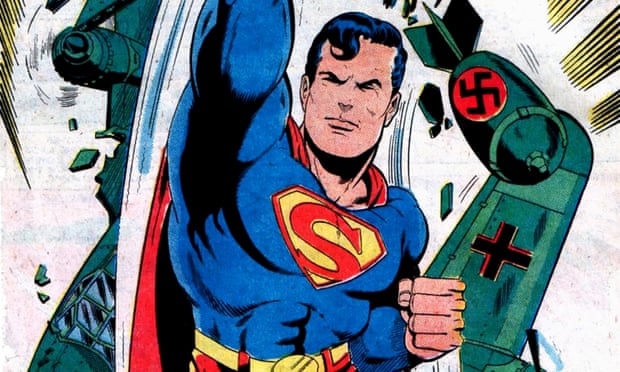
A 1977 reprise of Superman’s fight with the Nazis, inspired by his creators. Photograph: DC Comics
It was February 1940 when two American friends dreamt up how Superman would stop the second world war.
“Put me down! You are hurting me,” Adolf Hitler protests to the man of steel. But Superman has other ideas. Seizing the Nazi dictator, Superman shoots into the air, faster than any plane, to pick up Josef Stalin in Moscow. Next stop Geneva to drop off the “power mad scoundrels” at the League of Nations, where they are found guilty of “unprovoked aggression against defenseless countries”.
The cartoon strip How Superman Would End the War appeared in Look Magazine, almost two years before the US entered the conflict against Nazi Germany as allies of the Soviet Union. At the time, few knew that the creators of Superman, the scenarist Jerry Siegel and the draughtsman Joe Shuster, were children of Jewish immigrants.
An exhibition at the Jewish Museum of Belgium in Brussels is tracing the Jewish backgrounds of the US’s best-known superheroes, including Superman, Batman and Captain America.
The exhibition’s curator, Bruno Benvindo, believes firstand second-generation Jewish immigrants to the US were drawn to comics, partly because of low barriers to entry. “You don’t need a lot of technology to make a comic, just a pen and a good story,” he says.
He adds: “I am not saying it was easy for them. It was very hard because the publishing houses were ruthless for these young and sometimes naive creators.”
Siegel and Shuster sold the rights to Superman for $130 in 1938. They spent years on the breadline before Warner, the Superman filmmaker and then comic’s owner, agreed in the 1970s to give them a pension.
The exhibition traces a century of American comics, starting with the basic three-box strips in newspapers, often in “Yinglish”, a mix of Yiddish and English. One was Abie the Agent, a car salesman, created by Harry Hershfield, the son of a Jewish immigrant, Abie was the first Jewish character syndicated across the US.
In the late 1970s Will Eisner, a pioneer of the industry, wrote A Contract with God, a semi-fictionalised account of a Jewish family in the Bronx that transformed the comic into the graphic novel.
Eisner inspired Art Spiegelman, who won a Pulitzer prize for Maus, which recounts how his father survived Auschwitz.
Persecution was also explored in popular culture by the duo who created Captain America and Hulk, in their later series X-Men, launched in 1963. Jack Kirby and Stan Lee were both sons of Jewish immigrants. In X-Men, mutants are victimised for their differences. Superheroes Never Die, at the Jewish Museum of Belgium, until 26 April
Nagina (1986 film) (The snake dance in Bride and Prejedice is another version ) From Wikipedia, the free encyclopedia Jump to navigation Jump to search For the 2014 film, see Nagina (2014 film) . Template:More citations nery 2017 Nagina Theatrical Release Poster Directed by Harmesh Malhotra Produced by Harmesh Malhotra Written by Dr. Achala Nagar Screenplay by Ravi Kapoor Story by Jagmohan Kapoor Starring Sridevi Rishi Kapoor Komal Mahuvakar Amrish Puri Prem Chopra Music by Laxmikant-Pyarelal Cinematography V. Durga Prasad Edited by Govind Dalwadi Production company Emkay Enterprises Distributed by Emkay Enterprises Release date 28 November 1986 Country India Language Hindi Box office ₹ 13 crore (equivalent to ₹ 132 crore or US$19 million in 2018) Nagina is 1986 Indian fantasy film , produced and directed by Harmesh Malhotra , with a screenplay written by Ravi Kapoor and story by Jagmohan Kapoor. Starring Sr...
Comment : the Dragon is giving the US something to think about for xmas .... or what ..... Dr. Strangelove From Wikipedia, the free encyclopedia Jump to navigation Jump to search For other uses of "Strangelove", see Strangelove (disambiguation) . Dr. Strangelove Theatrical release poster by Tomi Ungerer Directed by Stanley Kubrick Produced by Stanley Kubrick Screenplay by Stanley Kubrick Terry Southern Peter George Based on Red Alert by Peter George Starring Peter Sellers George C. Scott Sterling Hayden Keenan Wynn Slim Pickens Tracy Reed Music by Laurie Johnson Cinematography Gilbert Taylor Edited by Anthony Harvey Production company Hawk Films Distributed by Columbia Pictures Release date January 29, 1964 Running time 94 minutes [1] Country United Kingdom [2] United States [2] Language English Budget $1.8 million [3] Box office $9.4 million (North America) [3] ...
Fritz Lang From Wikipedia, the free encyclopedia Jump to navigation Jump to search For the German painter, see Fritz Lang (artist) . Fritz Lang Lang in 1969 Born Friedrich Christian Anton Lang December 5, 1890 Vienna , Austria-Hungary Died August 2, 1976 (aged 85) Beverly Hills, California , U.S. Resting place Forest Lawn Memorial Park Citizenship Austrian German American [1] Occupation Filmmaker film producer actor Years active 1919–1963 Spouse(s) Lisa Rosenthal ( m. 1919; her death 1921) Thea von Harbou ( m. 1922; div. 1933) Lily Latté ( m. 1971; his death 1976) Friedrich Christian Anton " Fritz " Lang (December 5, 1890 – August 2, 1976) was an Austrian-German-American filmmaker, screenwriter, and occasional film producer and actor. [2] One of the best-known émigrés from Germany's school of Expressionism , he was dubbed the "Master of Darkness" by the Bri...



Comments
Post a Comment