Comedy ;Yesterday, Today and Tomorrow film by Vittorio De Sica (comment)
A realistic view on Life

Yesterday, Today and Tomorrow
Jump to navigation
Jump to search
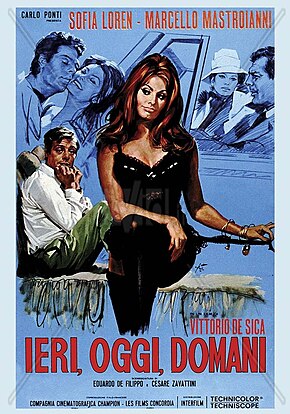
Yesterday, Today, and Tomorrow (Italian: Ieri, oggi, domani) is a 1963 comedy anthology film by Italian director Vittorio De Sica.[2] It stars Sophia Loren and Marcello Mastroianni. The film consists of three short stories about couples in different parts of Italy. The film won the Academy Award for Best Foreign Language Film at the 37th Academy Awards.[3]
| Yesterday, Today and Tomorrow | |
|---|---|

original movie poster
| |
| Directed by | Vittorio De Sica |
| Produced by | Carlo Ponti Joseph E. Levine |
| Written by | Bella Billa Eduardo De Filippo Alberto Moravia Isabella Quarantotti Cesare Zavattini |
| Starring | Sophia Loren Marcello Mastroianni |
| Music by | Armando Trovajoli |
| Cinematography | Giuseppe Rotunno |
| Edited by | Adriana Novelli |
| Distributed by | Embassy Pictures Corporation |
Release date
|
|
Running time
| 118 minutes |
| Country | Italy |
| Language | Italian |
| Box office | $4.1 million (US/Canada) (rentals)[1] |
Contents
Plot
Adelina of Naples
Set in the poorer Naples in 1954, Adelina (Loren) supports her unemployed husband Carmine (Mastroianni) and child by selling black market cigarettes. When she doesn't pay a fine, her furniture is to be repossessed. However her neighbors assist her by hiding the furniture. A lawyer who lives in the neighborhood advises Carmine that, as the fine and furniture are in Adelina's name, she will be imprisoned. However, Italian law stipulates that women cannot be imprisoned when pregnant or within six months after a pregnancy. As a result, Adelina schemes to stay pregnant continuously. After seven children in eight years, Carmine is seriously exhausted and Adelina must make the choice of being impregnated by their mutual friend Pasquale (Aldo Giuffrè) or be incarcerated.She finally chooses to be incarcerated, and the whole neighborhood gathers money to free her and petition for her pardon, which finally comes and she is reunited with her husband Carmine and their children.
Anna of Milan
Anna (Loren dressed by Christian Dior), the wife of a mega-rich industrialist, has a lover named Renzo (Mastroianni). Whilst driving together in her husband's Rolls-Royce, Anna must determine which is the most important to her happiness – Renzo or the Rolls. Renzo rethinks his infatuation with Anna when she expresses no concern when they nearly run over a child, and end up crashing the Rolls-Royce.She is infuriated by the damage to her Rolls-Royce, and ends up getting another passing driver to take her home, leaving Renzo on the road.
Mara of Rome
Mara (Loren) works as a prostitute from her apartment, servicing a variety of high class clients including Augusto (Mastroianni), the wealthy, powerful and neurotic son of a Bologna industrialist.Mara's elderly neighbor's grandson Umberto is a handsome and callow young man studying for the priesthood but not yet ordained. Umberto and Mara talk one night asking each other about their occupations. Embarrassed, Mara tells him she does manicures. Umberto’s grandmother sees them talking and, knowing that Mara is a prostitute, interrupts their conversation telling Mara that she’ll go to hell. Umberto protests, but Mara defends herself. Umberto falls in love with her. To the shrieking dismay of his grandmother, the young man wishes to leave his vocation to be with Mara, or to join the French Foreign Legion, if Mara rejects him. Mara vows to set the young man on the path of righteousness back to the seminary and vows celibacy for a week, if she succeeds. For this, she enlists the reluctant Augusto. Mara then provides a striptease at the climax of the film.
Hier, aujourd'hui et demain
Sauter à la navigation
Sauter à la recherche
Hier, aujourd'hui et demain (Ieri, oggi, domani) est un film franco-italien réalisé par Vittorio De Sica, sorti en 1963.
Il a obtenu l'Oscar du meilleur film en langue étrangère en 1965.
 Ne doit pas être confondu avec
Hier, aujourd'hui et demain

| Titre original | Ieri, oggi, domani |
|---|---|
| Réalisation | Vittorio De Sica |
| Scénario | Eduardo De Filippo Cesare Zavattini Bella Billa Lorenza Zanuso |
| Acteurs principaux | |
| Pays d’origine |  Italie Italie France France |
| Genre | comédie |
| Durée | 118 minutes |
| Sortie | 1963 |

Il a obtenu l'Oscar du meilleur film en langue étrangère en 1965.
Sommaire
Synopsis
Le film est composé de trois segments se déroulant dans les trois plus grandes villes italiennes (Naples, Milan et Rome), tous trois interprétés par le duo Sophia Loren - Marcello Mastroianni et réalisés par Vittorio De Sica épaulé par de grands scénaristes.
- Épisode Adelina de Naples
L'histoire est tirée de celle de la contrebandière napolitaine Concetta Muccardi, qui pour ne pas aller en prison eut au moins dix-neuf grossesses, dont sont nés sept enfants1. Cette femme a continué son activité de vendeuse de cigarettes à la sauvette jusqu'à sa mort à l'âge de soixante-dix-huit ans.
- Épisode Anna de Milan
- Épisode Mara de Rome

Sophia Loren dans la scène du strip-tease.
Le strip-tease de Mara devant son client de Bologne, sur l'air Abat-jour2, est resté dans les annales du cinéma. La scène inoubliable sera réécrite dans Prêt-à-Porter de Robert Altman trente années plus tard3, avec une Sophia Loren toujours captivante et un Marcello Mastroianni qui cette fois ... s'endort.
Vittorio De Sica
Jump to navigation Jump to search
Vittorio De Sica
| |
|---|---|
De Sica in 1959
| |
| Born | 7 July 1901 |
| Died | 13 November 1974 (aged 73) |
| Occupation | Director, actor |
| Years active | 1917–1974 |
| Spouse(s) |
|
| Children |
|
Four of the films he directed won Academy Awards: Sciuscià and Bicycle Thieves (honorary), while Yesterday, Today and Tomorrow and Il giardino dei Finzi Contini won the Academy Award for Best Foreign Language Film. Indeed, the great critical success of Sciuscià (the first foreign film to be so recognized by the Academy of Motion Picture Arts and Sciences) and Bicycle Thieves helped establish the permanent Best Foreign Film Award. These two films are considered part of the canon of classic cinema.[1] Bicycle Thieves was cited by Turner Classic Movies as one of the 15 most influential films in cinema history.[2]
De Sica was also nominated for the 1957 Oscar for Best Supporting Actor for playing Major Rinaldi in American director Charles Vidor's 1957 adaptation of Ernest Hemingway's A Farewell to Arms, a movie that was panned by critics and proved a box office flop. De Sica's acting was considered the highlight of the film.[3]
Contents
Life and career
Born into poverty in Sora, Lazio (1901), he began his career as a theatre actor in the early 1920s and joined Tatiana Pavlova's theatre company in 1923. In 1933 he founded his own company with his wife Giuditta Rissone and Sergio Tofano. The company performed mostly light comedies, but they also staged plays by Beaumarchais and worked with famous directors like Luchino Visconti.His meeting with Cesare Zavattini was a very important event: together they created some of the most celebrated films of the neorealistic age, like Sciuscià (Shoeshine) and Bicycle Thieves (released as The Bicycle Thief in America), both of which De Sica directed.
De Sica appeared in the British television series The Four Just Men (1959).
Private life
His passion for gambling was well known. Because of it, he often lost large sums of money and accepted work that might not otherwise have interested him. He never kept his gambling a secret from anyone; in fact, he projected it on characters in his own movies, like Count Max (which he acted in but did not direct) and The Gold of Naples, as well as in General Della Rovere, a film directed by Rossellini in which De Sica played the title role.In 1937 Vittorio De Sica married the actress Giuditta Rissone, who gave birth to their daughter, Emi. In 1942, on the set of Un garibaldino al convento, he met Spanish actress Maria Mercader (sister of Ramon Mercader, Leon Trotsky's assassin), with whom he started a relationship. After divorcing Rissone in France in 1954, he married Mercader in 1959 in Mexico, but this union was not considered valid under Italian law. In 1968 he obtained French citizenship and married Mercader in Paris. Meanwhile, he had already had two sons with her: Manuel, in 1949, a musician, and Christian, in 1951, who would follow his father's path as an actor and director.
He was a Roman Catholic.[4] Although divorced, De Sica never parted from his first family. He led a double family life, with double celebrations on holidays. It is said that, at Christmas and on New Year's Eve, he used to put back the clocks by two hours in Mercader's house so that he could make a toast at midnight with both families. His first wife agreed to keep up the facade of a marriage so as not to leave her daughter without a father.
Vittorio De Sica died at 73 after a surgery due to lung cancer at the Neuilly-sur-Seine hospital in Paris.


Comments
Post a Comment