The Death Of A Salesman film
Death of a Salesman (1985 film)
Death of a Salesman 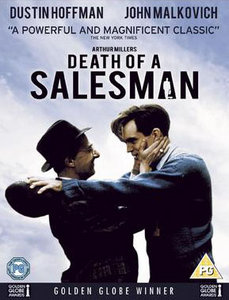
DVD cover
Genre Tragedy Based on Death of a Salesman
by Arthur Miller Written by Arthur Miller Directed by Volker Schlöndorff Starring Dustin Hoffman
Kate Reid
John Malkovich
Stephen Lang Music by Alex North Country of origin United States Original language(s) English Production Producer(s) Robert F. Colesberry
Michael Nozik (associate producer)
Nellie Nugiel (associate producer) Production location(s) Kaufman Astoria Studios - 3412 36th Street, Astoria, Queens, New York City, New York Cinematography Michael Ballhaus Editor(s) David Ray Running time 136 minutes Production company(s) Roxbury Productions
Punch Productions Distributor Shout! Factory Release Original network CBS Picture format Color Audio format Mono Original release August 16, 1985
Death of a Salesman is a 1985 American made-for-television film adaptation of the 1949 play of the same name by Arthur Miller, directed by Volker Schlöndorff, starring Dustin Hoffman, Kate Reid, John Malkovich, Stephen Lang and Charles Durning. The film follows the script of the 1949 play almost exactly and originally premiered on CBS on August 16, 1985.
The film earned 10 Emmy nominations at the 38th Primetime Emmy Awards ceremony and four Golden Globe nominations at the 43rd Golden Globe Awards ceremony, winning three and one, respectively.[1][2][3][4][5]
| Death of a Salesman | |
|---|---|

DVD cover
| |
| Genre | Tragedy |
| Based on | Death of a Salesman by Arthur Miller |
| Written by | Arthur Miller |
| Directed by | Volker Schlöndorff |
| Starring | Dustin Hoffman Kate Reid John Malkovich Stephen Lang |
| Music by | Alex North |
| Country of origin | United States |
| Original language(s) | English |
| Production | |
| Producer(s) | Robert F. Colesberry Michael Nozik (associate producer) Nellie Nugiel (associate producer) |
| Production location(s) | Kaufman Astoria Studios - 3412 36th Street, Astoria, Queens, New York City, New York |
| Cinematography | Michael Ballhaus |
| Editor(s) | David Ray |
| Running time | 136 minutes |
| Production company(s) | Roxbury Productions Punch Productions |
| Distributor | Shout! Factory |
| Release | |
| Original network | CBS |
| Picture format | Color |
| Audio format | Mono |
| Original release | August 16, 1985 |
Death of a Salesman is a 1985 American made-for-television film adaptation of the 1949 play of the same name by Arthur Miller, directed by Volker Schlöndorff, starring Dustin Hoffman, Kate Reid, John Malkovich, Stephen Lang and Charles Durning. The film follows the script of the 1949 play almost exactly and originally premiered on CBS on August 16, 1985.
The film earned 10 Emmy nominations at the 38th Primetime Emmy Awards ceremony and four Golden Globe nominations at the 43rd Golden Globe Awards ceremony, winning three and one, respectively.[1][2][3][4][5]
Plot[edit]
Willy Loman returns home exhausted after a canceled business trip. Worried over Willy's state of mind and recent car crash, his wife Linda suggests that he asks his boss Howard Wagner to allow him to work in his home city so he will not have to travel. Willy complains to Linda that their son Biff, who is visiting, has yet to make good on his life. Despite Biff's promise as an athlete in high school, he flunked senior year math and never went to college.
Willy is prone to frequent flashbacks in which he sees events and figures from his past, such as his long-deceased older brother Ben, Willy's idol. Unable to distinguish between his memories and present-day reality, he speaks to the people in his flashbacks as if they were real, startling those around him. Biff and his brother Happy, who is also visiting, discuss their father's mental degradation while reminiscing about their childhood together. When Willy walks in, angry that the two boys have never amounted to anything, Biff and Happy tell Willy that Biff plans to make a business proposition the next day in an effort to pacify their father.
The next day, Willy goes to ask Howard for a job in town while Biff goes to make a business proposition, but neither are successful. Willy gets angry and ends up getting fired when Howard tells him that he needs a rest and can no longer represent the company. Biff waits hours to see a former employer who does not remember him and turns him down. Biff impulsively steals a fountain pen. Willy then goes to the office of his neighbor, Charley, where he runs into Charley's son Bernard (now a successful lawyer). Bernard tells him that Biff originally wanted to do well in summer school to salvage his academic and athletic career after flunking math, but when Biff made an emergency trip to Boston to seek help from Willy, who was then on a sales trip, something occurred there that changed Biff's mind.
Happy, Biff, and Willy meet for dinner at a restaurant, but Willy refuses to hear bad news from Biff. Happy tries to get Biff to lie to their father. Biff tries to tell him what happened as Willy gets angry and slips into a flashback of what happened in Boston the day Biff came to see him. Willy had been in a hotel on a sales trip with a young woman named Miss Francis when Biff unexpectedly arrived and realized that Willy was cheating on Linda. From that moment, Biff's view of his father and all of his father's cherished hopes and dreams for him changed irrevocably, setting Biff adrift.
Biff leaves the restaurant in frustration, followed by Happy and two girls, Miss Forsythe and Letta, that Happy has picked up. They leave a confused and upset Willy behind in the restaurant. When they later return home, their mother angrily confronts them for abandoning their father while Willy remains talking to himself outside. Biff goes outside to try to reconcile with Willy. The discussion quickly escalates into another argument, at which point Biff forcefully tries to convey to his father that he is not meant for anything great, that he is simply ordinary, insisting that they both are. The feud culminates with Biff hugging Willy and crying as he tries to get him to let go of the unrealistic dreams that he still carries for Biff and wants instead for Willy to accept him for who he really is. He tells his father he loves him.
Rather than listen to what Biff actually says, Willy realizes that his son has forgiven him and thinks that Biff will now pursue a career as a businessman. Willy -- with encouragement from Ben, whom he "sees" and speaks to in one of his flashbacks -- kills himself by intentionally crashing his car so that Biff can use the life insurance money to start his business. However, at the funeral, Biff retains his belief that he does not want to become a businessman. Happy, on the other hand, chooses to follow in his father's footsteps.


Comments
Post a Comment